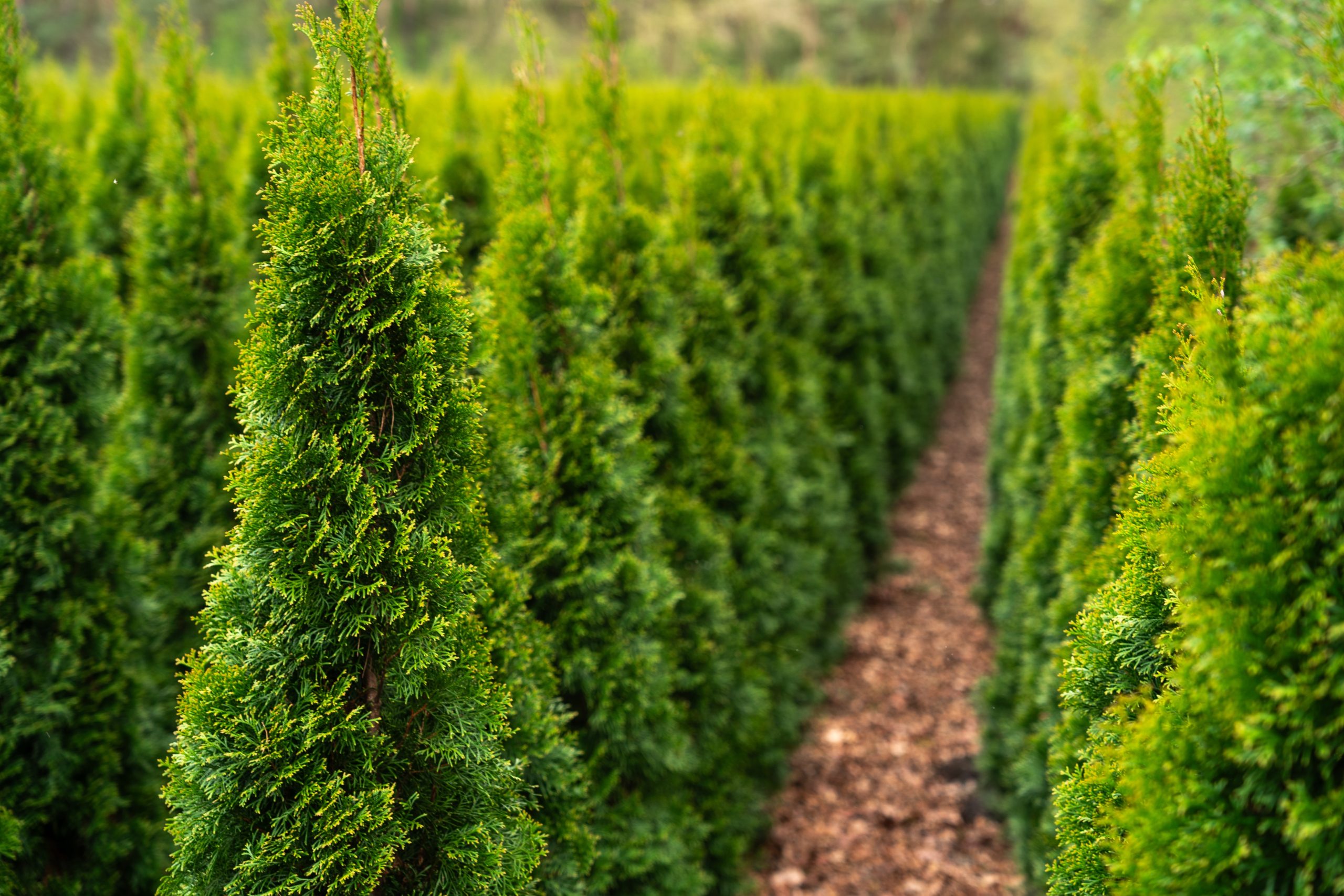
Thuja hedges are among the most popular hedges. They are evergreen and dense. Thuja Brabant is popular for its fast, somewhat vigorous growth of about 30 cm per year. It is often trimmed as a rectangular hedge. If it is allowed to grow freely, it becomes more columnar and can grow over six metres tall. Smaragd is somewhat slower, at 15–25 cm per year. Its growth habit is more pointed/pyramidal, meaning wider at the bottom and narrowing towards the top, and it can grow to just over 3 metres tall. The spring sun can cause damage to the plants. If they are in full sun in late winter/early spring with frost in the ground, you should cover them with shade cloth, burlap, or similar. Plants that receive too much sun while the ground is frozen cannot access water and cannot replace the moisture that is lost. This causes drought damage in the form of brown needles and can make the hedge sparse. It is therefore important to plant container-grown plants with undamaged roots in autumn. For spring planting, bare-root plants or plants with a root ball also work well. Pruning should be done in late winter/early spring once the frost has left the ground. Remove dead and frost-damaged branches and lightly trim a few centimetres on the sides. Never cut back further than where there are still green, healthy needles (fresh wood) left. Preferably trim in cloudy weather to avoid drying damage at the cut surfaces, and protect it during the first few days after trimming. A second trimming can be done in August/Sept. Do not trim the height until 15 cm below the desired height. It is important to trim every year for a lush and even hedge. Thuja Brabant generally needs trimming more often than Smaragd.
Planting Thujas
• Dig a trench that is at least 40 cm deep and 40 cm wide. • Spread cow manure, about 1 bag per 10 m, in the bottom of the trench. • Pour soil improver over the excavated soil, about 100 litres/10 m, and add a few handfuls of cow manure per metre, then mix. If you have sandy soil, a moisture-retaining improver such as planting peat/soil is best. If the soil is clayey and hard, bark mulch is best for creating loose soil. • Shovel the soil mixture back into the trench until it is full (there is usually soil left over). • Stretch a string to get a straight line when planting. • Plant 2–5 hedge plants per metre of hedge depending on the size of the thuja plants. Make sure all roots are properly covered and press down gently. The plants should be positioned a few centimetres deeper than the branching point. • When all hedge plants are planted and pressed down, there should be a small depression left in the trench. • Water thoroughly, fill the depression with water and let it soak in. Repeat watering once more. • Now take the remaining soil and top up so that you create a small ridge along the hedge planting. This keeps the soil loose at the top and makes it easy to remove any weeds.
On delivery
• Unpack your plants immediately from the transport packaging.
• Water your container-grown plants thoroughly.
Watering
• When watering, it is important to water thoroughly and not too often. Thorough watering means checking that the soil becomes moist all the way down to the roots. Preferably water in stages with a few minutes in between so the water has time to soak in. If you water too often (such as every day), the soil cools down and prevents the plants’ roots from developing. If the air is warmer than the soil, the plants will struggle to absorb water to the extent they need. Normally, it is sufficient to water 1–2 times per week during establishment. • For autumn planting, watering is usually only needed at the time of planting. When spring arrives, pay attention to watering during prolonged drought and water according to points 1–3.
Fertilising
Fertilise your hedge in early spring and at the beginning of August with granular garden fertiliser such as Blåkorn or similar to keep the hedge healthy, resilient, and growing well. Do not use lawn fertiliser, as it may contain substances that are harmful to the hedge.